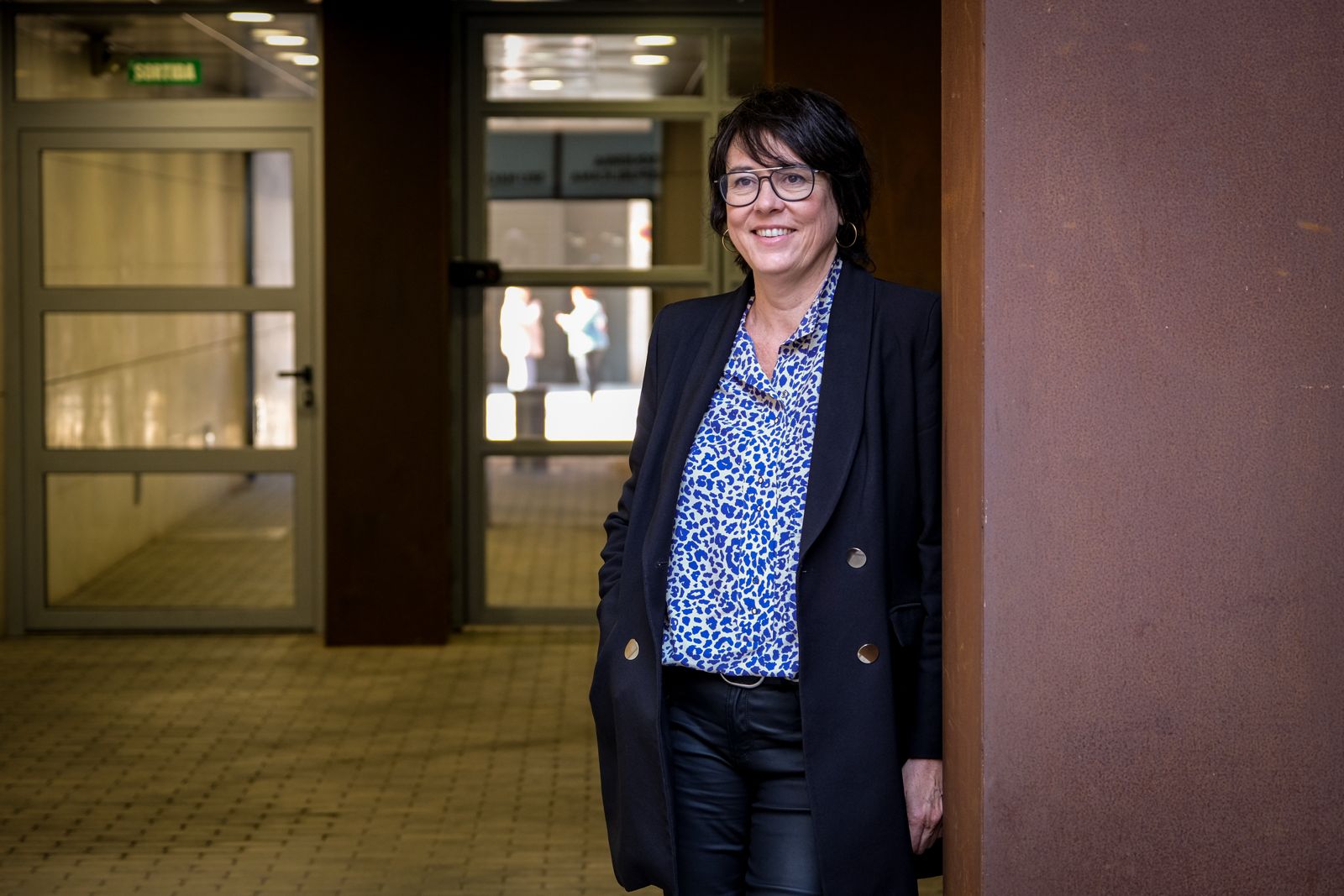
Having served as a Member of the European Parliament since 2019, Diana Riba MEP became President of the European Free Alliance (EFA) Group in the European Parliament in 2024. She represents Esquerra Republicana de Catalunya.
In Parliament, she has been particularly active on civil liberties and justice, with a strong focus on fundamental rights, democracy, and gender equality. She combines a clear pro-European outlook with a firm commitment to self-determination and to the defense of minority and stateless nations’ rights within the European Union.
Q: It’s your second term as an EFA MEP. In 2024, you were re-elected and became the President of the EFA Group in the European Parliament. How has this term been so far? Has something changed compared to before?
A: It’s a very different term from the previous one. Majorities have changed and, therefore, everything has shifted. We constantly must find alliances to build majorities and, as a result, it becomes much more difficult for those of us who have clear principles.
Q: How do the other European Parliament groups relate to EFA’s struggles and what we represent?
A: One of the main topics in the Parliament right now is the regional funds: the Commission aims to centralize to the state capitals all the money that used to be directly allocated to the regions. In this context, our regionally focused perspective and the policies that we have been developing at the regional level are well known and appreciated. We have a strong voice in the struggle against the centralization of the EU.
Q: Which topics are we prioritizing to have a voice in?
A: In this term, we want to focus on the issues that matter the most to people.
The first one is housing, which is becoming an emergency in many places in the EU. Another is the situation of the islands across Europe — we have many of them within our political parties — and this island statute that is so strongly desired and so greatly needed. And then, of course, the right of regions and peoples to decide, to express their views, and to manage their own day-to-day politics.
Q: Which are your main responsibilities at the European Parliament?
A: In this term, within the political group, I am President of the EFA Group and Vice-President of the entire Greens–EFA group. In the European Parliament, I am a member of the Committee of Culture. It is my second term there, and I serve as Vice-President and group coordinator.
I also hold a seat on the LIBE (Committee on Civil Liberties, Justice and Home Affairs) and AFET (Committee on Foreign Affairs) committees and participate actively in them. In addition, at the European Parliament we work through delegations, which are the groups responsible for parliamentary diplomacy with third countries. In this regard, I am President of the Central America delegation, and I am also involved with the Mexico delegation.
Q: Which are your responsibilities as President of the EFA Group in the European Parliament?
A: Like the presidents of every parliamentary group, I hold a more institutional role. Also, since we are part of the Greens parliamentary group, I am also the First Vice-President of the entire Greens group. Therefore, there is a very diplomatic day-to-day aspect in the President’s position, involving contact with the other political groups in order to work on reaching alliances to push the policies that are so important to us.
Q: Any recent relevant political wins to celebrate?
A: We are currently negotiating the budget, and the whole area of culture is holding up well, remaining at economic levels fairly similar to the previous budget. As negotiations are still ongoing, we cannot celebrate anything yet. But if confirmed, this will be a major victory. In the face of the trend of allocating millions and millions to security and defence, ensuring that this area — culture and Europe’s linguistic and cultural diversity — does not lose funding is indeed a significant achievement.
Q: What will this mean for diversity in Europe?
A: To give a clear example: when a citizen opens a streaming platform to watch a film — any platform — they should be able to access the widest possible range of subtitles, not only in the official languages, but in all European languages. Likewise, they should be able to discover films produced from diverse cultural perspectives across Europe.
Q: Why is it important that the different peoples of the EU work together in a project like EFA at the European level?
A: Because we have a vision of Europe that is very different from that of many political parties, which tend to be highly centralist and aim for the homogenization of everything: culturally, linguistically, and politically. What we want is to legislate from diversity, and it is from diversity that we can build European strength. That is why it is so important to have as many EFA MEPs as possible.
Q: Which are the main challenges for the EU right now?
A: They change every day. We saw it this January when Trump shook things up and altered many international rules. This is one of the aspects we are keeping very much in mind for the coming years: how we engage politically at the international level. At the same time, of course, we continue to deal with critical issues such as European security and defence, including the war in Ukraine, while not losing sight of Europe’s social pillars, such as healthcare, education, and housing, which we discussed earlier.
In this context, we must make sure that the pressing day-to-day issues do not overshadow the larger political objectives: strengthening the European Union economically, defending human rights, and reinforcing peace.
Q: How can we, as EFA and EFA members, contribute?
A: Our movements are particularly strong at this kind of mediation: not allowing the strongest to win but ensuring that everyone compromises. It’s about embracing a vision of the common good, recognizing that no one can truly thrive if their neighbour is struggling.
This broader perspective on what a society is — its diversity — shows that we don’t just need policies, but plural policies, because the challenges differ for each family, each community, and each region. I believe that our perspective, that of the European Free Alliance, is the one that contributes the most to bringing the greatest richness to the European Parliament.
Q: You are representing the EFA member party in Catalonia, Esquerra Republicana, in the European Parliament. After the 2017 Catalan referendum, how has the situation evolved until today?
A: The situation is not the same as when most of the political leaders were imprisoned or exiled, and when there were three empty seats in the European Parliament because of repression. But the Catalan conflict is still far from solved. We still have political leaders who are not allowed to stand for elections, such as Oriol Junqueras or Raül Romeva. We still have people living in exile here in Belgium. We have a genuine interest in seeing how the conflict is ultimately resolved, but we are still far from closure. Even if the Socialist Party likes to talk about “normality”, nothing about our reality is still normal.