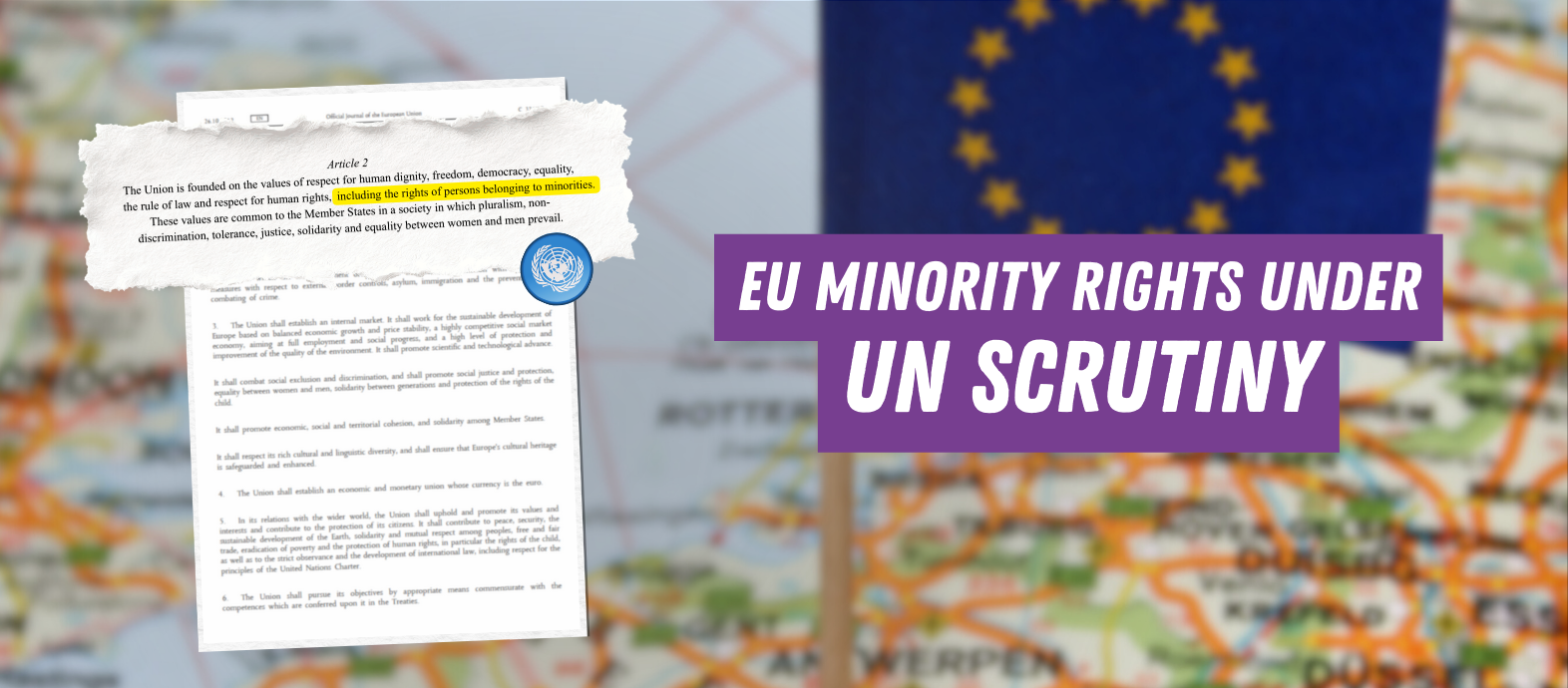
The European Free Alliance sent a dedicated briefing on minority rights in the EU to the UN Special Rapporteur, ahead of their visit to EU institutions this week
This week, the UN Special Rapporteur on minority issues, Nicolas Levrat, is finishing an extensive visit to the European Union. This visit aimed to examine the state of minority rights in Europe and will conclude with the publication of his report to the UN Human Rights Council in March 2027. The European Free Alliance, as the only European Political party that fights for the right to self-determination and minority rights as our core values, has a lot to say about this issue. This is why, prior to his visit to the EU, we sent him a briefing with our contribution, including real perspectives from minorities in the EU, which may be overlooked by the institutions.
We called the attention of Mr. Levrat to the inconsistency in the implementation of Article 2 of the Treaty on European Union, which enshrines “the values of respect for human dignity, freedom, democracy, equality, the rule of law and respect for human rights, including the rights of persons belonging to minorities”. In particular, EFA criticises the passivity of the EU in taking action when a Member State violates such an article. We welcome proposals for amending the Treaties, which include additional protections for regional minorities and for regional and minority languages. At the same time, we argue that, under Article 7 and numerous provisions of the Treaty, the EU institutions already have the discretionary power to impose penalties for breaches of minority rights.
The same applies to cases affecting minority rights published in the annual rule of law report. Minority groups in the EU have found that EU institutions have dismissed applications to act where a member state has systematically violated human rights law, on the grounds that the relevant cases were ruled under separate jurisdiction. This undermines the seriousness with which the EU seeks to guarantee the rights and freedom of persons belonging to minorities, she adds.
Centralization undermines inclusive education
When it comes to education, EFA recognizes the potential of EU initiatives promoting inclusion in helping access to education for minorities according to their specific needs. Nevertheless, the implementation by central governments limits their effectiveness. For example, in France, where no national minority is officially recognized, significant challenges exist in the teaching of the Breton language. In Greece, the Turkish minority faces major difficulties in providing instruction in its mother language. In Bulgaria and in Greece, the Macedonian minority is not granted the right to education in the Macedonian language. We believe that EU initiatives need to reach the targeted communities directly to be more effective.
Minorities underrepresented
In terms of political representation, it is frequently the case that candidate countries are already more advanced than many EU member states when it comes to minority representation. Many countries of the Western Balkans have multiple minority-representing parties, dedicated seats in the parliament, constitutional protections for minorities, and/or a prominent role for minority parties in public/political life. This contrasts with some EU member states, which, in some cases, do not allow any political representation based on national/minority identity (Bulgaria), do not allow regional-only parties (Portugal), or forbid the use of minority languages in parliament (France).
At the European level, minorities enjoy rather limited opportunities to be elected to the European Parliament due to electoral thresholds. While in some cases minority parties are explicitly exempted from the thresholds at the national level, there are no such exception at the European level. EFA opposes any initiative that proposes increasing electoral barriers and believes that granting representation of minorities in the EU would better contribute to a fair representation for all European citizens. Minorities are also systematically underrepresented in the Committee of the Regions, where members are selected by member states.
Prevented from fair political representation, civil society organizes. Citizens from different European minorities have developed several European Citizens’ Initiatives to make their voice heard in the institutions. The Minority Safe Pack Initiative and the ECI for Equality of Regions and Sustainability of Regional Cultures both managed to get over 1 million signatures for diversity. Nevertheless, EU institutions disregarded both proposals. We believe that the European Union should take more seriously direct proposals from EU citizens and give a proper answer to such demands.
Also, in the European Institutions, many EU citizens do not have the right to political representation in their own languages. From EFA, we propose transitioning from a state-based recognition to a people-based linguistic rights. We promote the adoption of all regional and minority languages as official languages of the EU.
Minorities are also systematically forgotten in statistical research. Minority belonging is not systematically sampled for, and ethnic or national identities, languages, and cultures of the local population are excluded. Therefore, Eurostat’s usefulness will remain rather limited in guiding the development of effective economic and social policies for minorities.
Uniformization of minority protection in the EU
In EFA, we believe that minorities should be equally protected across the EU. The Framework Convention for the Protection of National Minorities has not been signed by 4 Member States, while the European Charter for Regional Minority Languages has not been ratified by 11. In this scenario, EFA supports the proposal made by the EU Commission in 2021 of including hate speech and hate crime to the list of EU crimes.
EFA hopes that the information provided to the UN Special Rapporteur on minority rights will be useful for understanding the situation of minority rights in Europe. Our aim is to provide the vision of the minorities of the EU, a perspective that is sometimes different from the institutional insights. Listening to all citizens is key to having a full picture of an issue. Only by embracing all our diversity can the EU become a fair project that includes everyone.