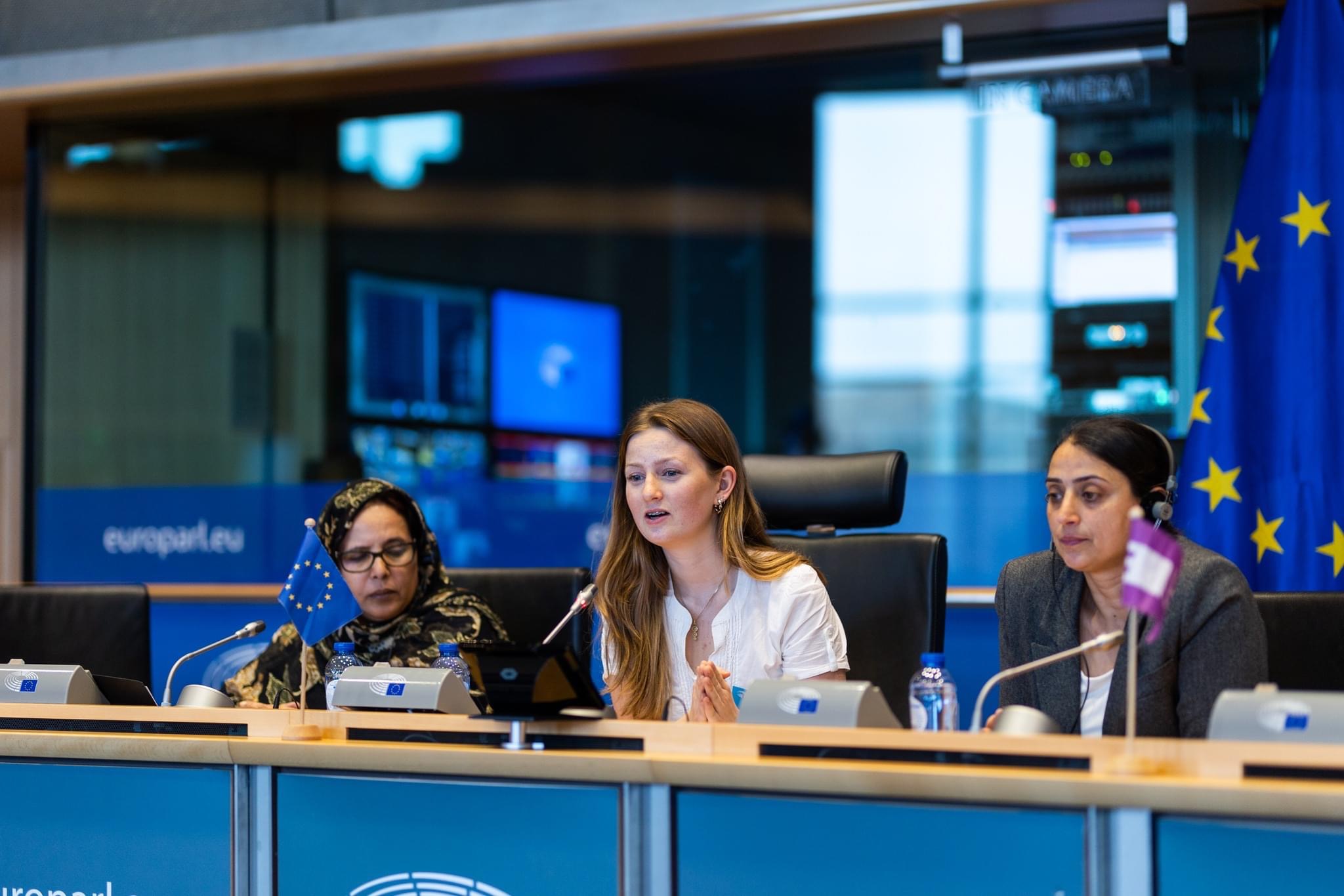
Katharina Kley (23, Northern Schleswig) was elected EFAY president last June in Gandia, during the EFAY General Assembly 2026. As the former President of Junge SPitzen, the youth organization of Schleswigsche Partei (SP), she represents the German minority in Denmark, where she grew up.
She speaks both German and Danish as her mother tongues and also speaks English and Spanish, having lived in Latin America for an extended period. She is currently studying a bachelor’s in environmental engineering at the Technical University of Denmark.
On the occasion of International Youth Day, Katharina Kley shares with us some impressions on the EU, the main challenges for European youth, youth connection to the European project, the new EFAY Bureau, and other pressing political topics in the EU agenda.
Q: You are the New President of EFAY. How do you face this challenge?
A: I’m representing a lot of people from many different realities. So, I face it with great motivation and a huge respect for our member organizations.
Q: If you had to sum up in one sentence what truly concerns young Europeans today, what would it be?
A: Our biggest concern is the uncertainty of the world right now. Not knowing what the future holds and not knowing whether we are going to be the first generation who will be worse off than our parents.
This generation is facing many struggles: the environmental crisis, the housing crisis, and several wars going on around the world. We are a generation that feels like we do not know what our future holds at all. And I think that reflects in a lot of ways on how my generation acts and votes. Also, on how we plan our lives.
Q: If you could remove one barrier that prevents young people from feeling European, what would it be?
A: The state-centric monopoly in European politics. A lot of young people feel that EU politics is a very distant concept, very Brussels-centric, very top-down, and very much focused on capital cities. Outside of the capital cities, it can feel very far away, very distant.
Removing this barrier and allowing nations and regions to have a more direct voice in Brussels or in the EU would make the European democracy feel much more inclusive. In many EU states, there’s such a big difference between the capital cities and other regions of the country. It’s simply not fair to only let capital cities and big organizations have a say.
“The state-centric monopoly in EU politics is a barrier for the youth to connect with the European project”
Q: In EFAY, you are not only young, but you also represent stateless nations, regions and minorities in Europe. What does your youth vision bring to the movement and to these struggles?
A: Minority identities are constantly changing. My minority identity is very different from that of my parents and my grandparents. For that reason, it’s very important that young voices are always included to take into account the future identity of the minority and what direction the young generation wants to go in.
On the other side, a lot of our members in EFAY operate in rural regions. In these rural regions, young people often face great challenges, since they offer fewer opportunities for them to build their futures around. Our opportunities for the future define everything, including how we plan our lives. It’s very important to include the perspective of the youth and make sure that these rural regions are prepared for the future and to offer what future generations need.
“Rural areas offer fewer opportunities for young people and that defines how we plan our lives”
Q: What differences have you noticed between the concerns of young people in different countries?
A: Since I joined EFAY, I noticed substantial differences between the youth of different EU countries. One of the most pressing ones relates to the job market. In some regions of Europe, there is a scarce availability of jobs, which means that there is no future for young people and they must move away. Not being able to start your career, especially right after university or right after finishing education, makes a whole difference when planning your future.
As someone coming from a rural region, but with bigger job availability and a more stable job market, this was a big surprise for me.
Q: What conversation do you think Europe is avoiding?
A: Minority languages. With everything else going on in the EU, this topic has been forgotten for a long time now, and there are still a huge number of EU citizens who cannot engage in EU politics in their mother tongues.
This also connects to what makes young people feel distant from the EU. Not being able to speak their language and having a hierarchy between languages and cultures is a barrier for young people to connect with the idea of the European Project.
“The conversation on minority languages has been long forgotten in the EU”
Q: How would you describe the new EFAY Bureau? What will your priorities be?
A: Most of the EFAY Bureau members are new. We come from different backgrounds and from different corners of Europe, in very different regions. We have somebody from Scotland, from the Spanish state, from the Italian state, the French state, and I’m from the Danish state.
We want to give EFAY a little lift, to focus on good organization, and to give a better experience to our members, both at events and in our communication. A lot of internal work, especially. We also want to look into new topics and new relevant partner organizations, because we think there is big potential there.
Q: If, at the end of your mandate, you could have changed only one thing within EFAY, what would you want it to be?
A: I hope that EFAY is going to be a very well-structured organization so that it’s ready to take on the challenges of the future. So, good communication and good coordination with its member parties, and a good internal structure. That’s something that I really want to focus on.
Q: You are also a Coordinator of the EFA Women’s Forum. Why is feminism important for you?
A: Equality has always been a huge part of my personal set of political motivation. Without gender equality – and equality in general – it is very hard to step forward in politics. And without including everyone, you will simply not push forward the right political solutions.
That is the base of doing good politics, including everyone. Feminism works towards equality between men and women, and all genders, so they are all able to participate in that conversation.
“Feminism is important because the base of good politics is including everyone”
Q: Which book, podcast, or person has influenced you the most over the past year?
A: I want to mention a book called “And Then What?” by Catherine Ashton. She was the High Representative for Foreign Affairs and Security Policy in Europe. I greatly recommend it; it is just a memoir from her about her work in different crisis. It focuses on crisis management and how to build lasting political solutions for big problems.
Q: If you could send a single message to Ursula von der Leyen, what would it be?
A: Get out of the capitals and get out of Brussels! Europe is so diverse and so much bigger than just capitals and big government buildings. The true beauty of Europe lies in this diversity and in including all corners: from stateless nations to minorities, to rural and border regions, where different people meet and coexist together.
“The true beauty of Europe lies in this diversity and in including all corners”